The definition of luxury in alpine real estate has relentlessly narrowed over the past decade. Previously, "mountain adjacent" or properties claiming a "short shuttle ride to the lifts" were considered premium assets. However, as ultra-high-net-worth individuals increasingly prioritize time and radical convenience over pure square footage, a distinct and isolated asset class has emerged: true, uncompromised ski-in/ski-out real estate.
There is a fundamental difference between proximity and true integration. One requires logistics—the packing of gear, the warming of vehicles, the navigation of icy mountain roads, and the inevitable friction of coordinating family members. The other offers absolute, frictionless freedom. True ski-in/ski-out access means clicking into your bindings in a private, heated ski lounge and descending directly onto the piste. It is the architectural equivalent of a private runway.
The Geological Ceiling on Supply
To understand the immense price premium commanded by piste-side property, one must first recognize the fundamental scarcity of the asset. Unlike traditional luxury markets—whether high-rise penthouses in tier-one cities or sprawling beachfront estates—true alpine ski-in/ski-out real estate is geologically and legally capped.
You cannot manufacture a new mountain with the necessary vertical drop and annual snowfall. Furthermore, the boundary of an existing ski resort is strictly regulated by a complex web of US Forest Service leases, environmental impact boundaries, and topographical realities. The developable land immediately adjacent to a ski run is a finite resource that, in most legacy resorts, was exhausted decades ago.
This intrinsic scarcity creates a formidable protective moat around the asset's value. In periods of economic turbulence, when broader real estate markets experience high volatility and price corrections, piste-side properties in major North American resorts historically demonstrate profound resilience. They act not merely as vacation homes, but as highly defensive, generational wealth preserves.
The Time Dividend
The ultra-luxury market is no longer driven by the accumulation of physical goods, but rather the aggressive acquisition of time. For the modern legacy owner, the most valuable commodity is not the marble on the countertops, but the hours reclaimed from logistical friction.
By acquiring at Powder Peak, investors are not just buying square footage; they are monopolizing the finite inventory of Chair Two access. This creates a highly defensive asset that acts as a generational wealth preserve.
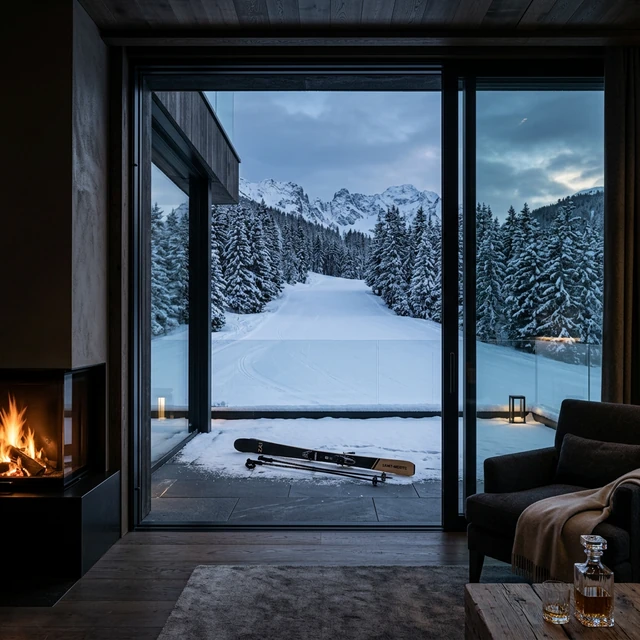
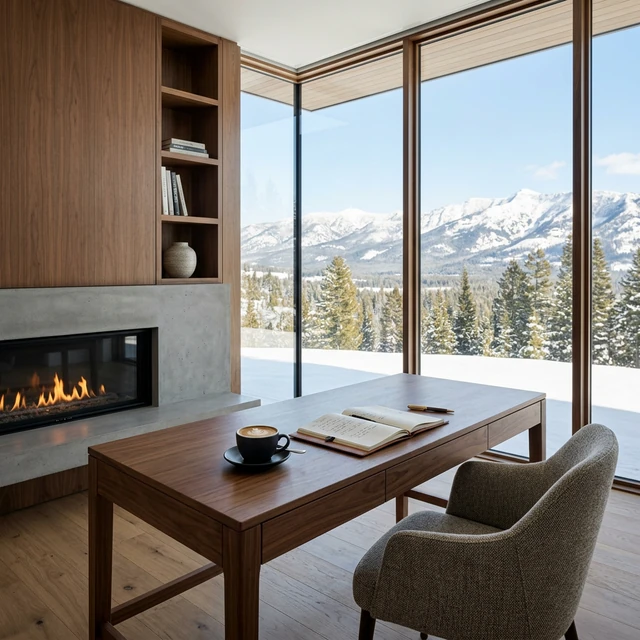
Consider a standard winter weekend for a family in a "mountain adjacent" property. The daily routine involves an average of ninety minutes lost to preparation, driving, parking, and queueing. Over a typical winter season, this equates to days of lost leisure time. In contrast, ownership at Powder Peak entirely eliminates this friction. Your equipment is prepped and warmed by the ghost concierge. You transition from the Wabi-Sabi warmth of your living room to the high-speed transit of Chair Two in less than three minutes.
This is the "Time Dividend" that drives the piste-side premium. It is the ability to ski for exactly forty-five minutes before a morning conference call, or to effortlessly drop the children off at ski school while returning to the sanctuary of your residence for coffee. This level of granular control over one's schedule is the ultimate luxury, and it is a lifestyle that buyers are willing to pay an extraordinary premium to secure.
The Whitefish Arbitrage
While mega-resorts like Aspen, Vail, and Jackson Hole have already realized their peak appreciation curves—often requiring an entry point exceeding thirty million dollars for true ski-in/ski-out access—Whitefish represents the critical "next frontier" of luxury alpine investment.
Whitefish Mountain Resort occupies a unique position in the North American ski landscape. It retains the authentic, rugged charm and deep community roots that legacy resorts have lost to over-commercialization. Yet, it quietly attracts the world's most discerning capital, drawn by the world-class skiing, the proximity to Glacier National Park, and the incredibly discreet, frictionless access provided by Glacier Park International Airport (FCA), roughly thirty minutes from the mountain base.
Yield and Generational Hold
The data surrounding piste-side real estate clearly indicates that these assets are rarely subjected to rapid turnover. They are "legacy holds"—properties acquired with the explicit intent of passing them down through generations. This low velocity of sales further restricts supply, driving up the premium for any new-release inventory that comes to market.
Powder Peak is engineered specifically for this demographic. It is not a speculative development; it is an architectural monolith designed for permanent curation. The integration of 1031 Exchange strategies, coupled with the unique tax advantages of Montana real estate, makes the acquisition not just an emotional lifestyle choice, but a highly sophisticated pillar of a broader wealth management strategy.
In the final calculus, the premium paid for ski-in/ski-out real estate is not a premium on the building materials. It is a premium paid for unparalleled access, the eradication of friction, and the absolute scarcity of the underlying land. For those positioned to act, the available slopeside residences at Powder Peak represent what may be the final opportunity to secure a generational foothold on the slopes of the Northern Rockies.